|
 
|

|
| |

| NOBLE FIR |
|
|
 |
|
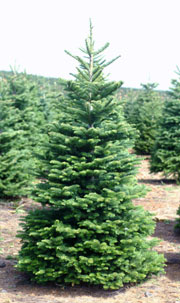
Long considered an excellent Christmas
tree because of its beauty, soft needles, stiff branches
and long keepability, the species is growing in popularity.
The Noble Fir (Abies procera) is a western North
American fir, native to the Cascade Range and Coast Range
mountains of extreme northwest California and western
Oregon and Washington in the United States.
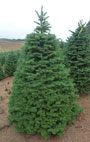
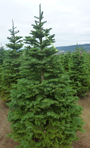
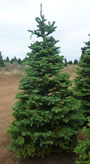
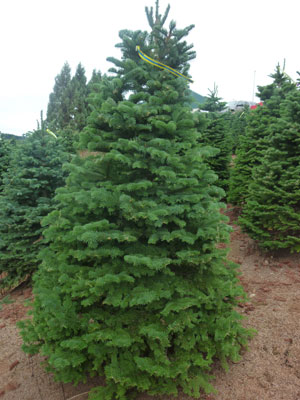
The branches of the Noble fir are evenly spaced and have
needles that are roughly 4-sided (similar to spruce),
over 1 inch long, bluish-green and are generally twisted
upward so that the lower surface of branches are exposed.
Extensive efforts are made to produce a beautiful Christmas
tree for the holiday season. Typically Noble firs are
sheared or trimmed once a year but when there is a second
growth another trim may be needed prior to being cut for
the season. Much care is needed to make sure that there
is a single straight top.
Nobles are fast becoming the most desired tree for the
holidays and they come in two standard grades developed
by the USDA. A USDA #1 Noble, can have one flaw such as
an open space or a slightly crooked top. A USDA #2 Noble
can have two flaws, however over the years science and
experience has helped us to continually increase quality
and grow more beautiful trees. The USDA grade is also
used for all other Christmas trees in the industry.
|
| |
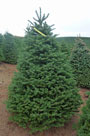
Number One Noble Fir - Click
for Larger Image
 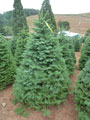 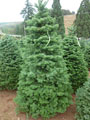
|
| |
Classic Noble Fir - Click
for Larger Image
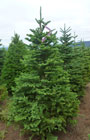 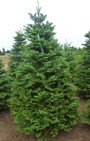 
|
| DOUGLAS-FIR |
|
|
 |
|
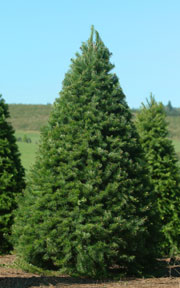
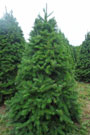
The
Douglas-fir (Pseudotsuga menziesii) has been
the major Christmas tree species used in the Pacific
Northwest since the 1920's. It is a wide ranging species
that strangely enough is actually not related to the
true firs. It grows throughout central California, western
Oregon and Washington, parts of the Rockies and extends
north to Alaska. It grows under a wide variety of environments
from extremely dry, low elevation sites to moist sites.
The branches are spreading to drooping and the buds
are sharply pointed. The bark is very thick, fluted,
ridged, rough and dark brown. Douglas firs are more
dense than their counterpart firs. Their needles are
dark green or blue green, 1 to 1 1/2 inches long, soft
to the touch and radiate out in all directions from
the branch. The needles have a sweet fragrance when
crushed.
Known as plantation trees, they are normally sheared
once per year and will typically produce a marketable
crop within 6 to over 8 years depending upon the site
and growing area as well as the size desired. Referred
to by the industry as Doug fir, they tend to grow a
little faster than Noble fir and also tend to be easier
to care for because of its ability to withstand more
harsh growing conditions.
Nationally, it remains one of the most popular Christmas
trees species. It is shipped to the majority of the
states and Hawaii and is also exported to Mexico, Guam
and some Asian markets. |
| |
Number One Douglas-fir - Click
for Larger Image
  |
| |
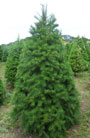
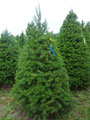
Medium-Sheared Douglas-fir
Click
for Larger Image
  |
| GRAND
FIR |
|
|
 |
|
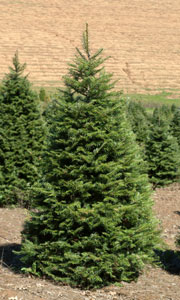
Known
for its dark green color and exceptionally aromatic
smell, the Grand fir (Abies grandis) is one
of the tallest firs, reaching heights of 300 feet. Its
popularity has also been increasing due to its needle
retention, color and dramatic scent. It is native to
the Pacific Northwest and grows in Oregon, Washington,
Idaho, Montana and up into British Columbia.
It is easily distinguished from other Pacific Northwest
firs by its sprays of lustrous needles in two distinct
rows. The needles are 1 to 1 1/2 inches long with glossy
dark green tops and two highly visible white lines of
stomata on the undersides giving it a somewhat shiny
appearance.
They are sheared and cared for and in most areas will
become a marketable tree in eight to ten years. |
| NORDMANN
FIR |
|
|
 |
|
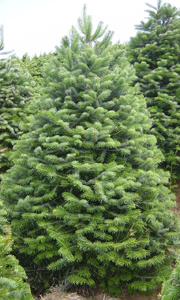
The Nordmann fir (Abies
nordmanniana) is an exotic tree that is gaining popularity
in the United States. It is native to the mountains
south and east of the Black Sea, in Turkey, Georgia
and Russia. They are grown in Denmark and other countries
for the European Christmas tree market.
The Nordmann fir have lush, full, rich dark green,
glossy foliage with needles a little over an inch
long, and grow from symmetrically arranged branches.
The branches are very strong, perfect for displaying
special or heavy ornaments. The needles are longer
and softer than those of other Christmas tree varieties.
The Nordmann is a very durable tree with excellent
needle retention. |
| |
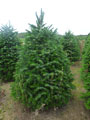
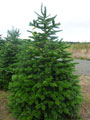
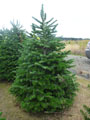
Number One Nordmann fir - Click
for Larger Image
  |
| |
Classic Nordmann fir - Click
for Larger Image
  |

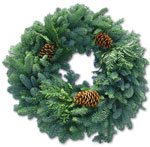
Mixed Wreath with Cones
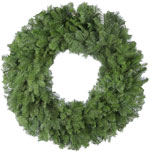
Noble Fir Wreath
|
|
Handcrafted premium quality Christmas wreaths
available. Constructed on sturdy wire frames using the
freshest boughs for maximum keepability. |
|
|
|
 |
|
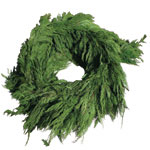
Fresh cedar garland available. Ask for details. |
|
|
|